How Wellington County is built
- Before 1961 25%
- 1961–1990 36%
- 1991–2000 13%
- 2001 or later 25%
This page covers the seven towns and townships of the County of Wellington. Guelph is a separate city with its own pages.
Why mould shows up in Wellington County homes
Environment and Climate Change Canada's 1981–2010 climate normal at Fergus Shand Dam (13.2 km from the middle of the area) is 4,307 heating degree-days a year, with a January mean of −7.4°C. On cold days, exterior corners, closets on outside walls and window frames get cold enough for condensation, which is where mould often starts.
Of the 31,695 houses in Wellington County (single-detached, semi-detached, row houses, duplexes and mobile homes), 25% were built before 1961 and 61% before 1991, according to the 2021 Census. Older basements without a moisture barrier, and houses air-sealed without adding ventilation, are common trouble spots.
Mould inspection: when sampling helps
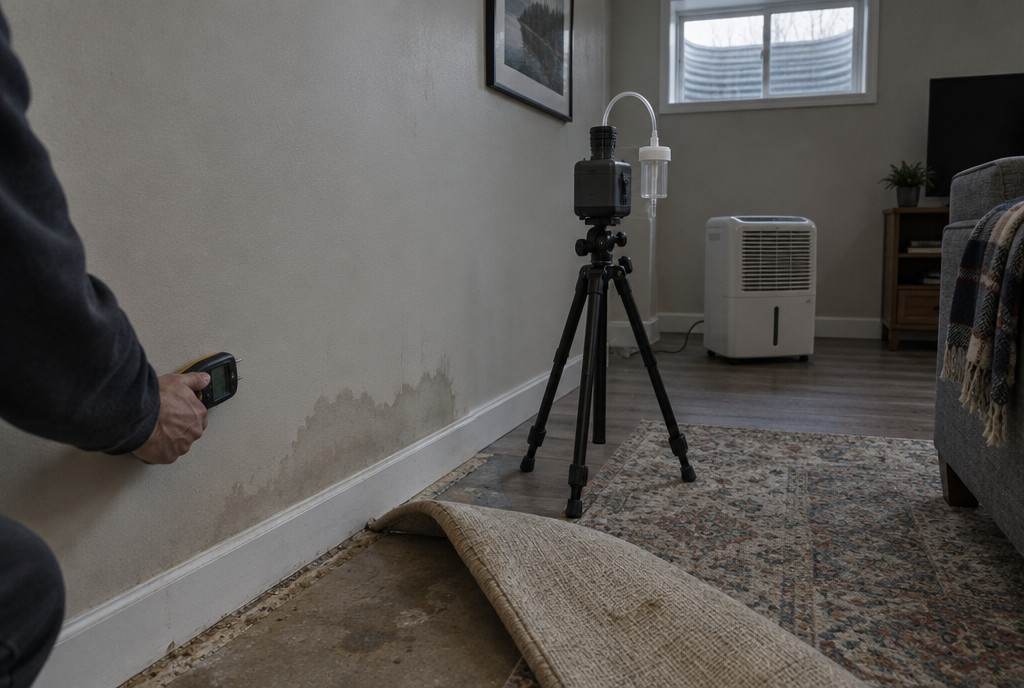
Start by looking and smelling: stains, discoloured patches, peeling paint and a musty odour, especially in basements, bathrooms, window frames and closets on outside walls. Health Canada says measuring mould concentrations or identifying species is usually unnecessary: if you can see or smell it, fix the moisture and clean up.
Air or surface sampling helps when you smell mustiness but can't find the source, after a leak or flood to check the cleanup worked, or before buying a house with signs of past water damage. Ask which lab analyzes the samples and look for one accredited under AIHA's EMLAP program.
Cleanup and remediation: the size rules
CMHC and Health Canada sort mould by size, and the size decides who should clean it up:
| Size | What counts | Who should clean it |
|---|---|---|
| Small | One to three patches, each smaller than 1 m² | A healthy homeowner, with water and unscented dish detergent (CMHC) |
| Medium | More than three patches, or patches between 1 and 3 m² (32 square feet) | Trained help; homeowners only with training and precautions |
| Large | A patch larger than 3 m², or many patches through the house | A qualified mould remediation contractor (CMHC) |
- Fix the moisture source first: a leak, poor drainage, or condensation from high humidity. Health Canada recommends 30–50% relative humidity.
- For a small cleanup, wear safety glasses or goggles, an N95 mask if possible and household rubber gloves. People at risk from mould shouldn't clean it and should stay away.
- Health Canada suggests professional help for extensive mould, especially growth that keeps coming back after cleaning.
Choosing a tester or contractor
Ask any tester which lab analyzes their samples and what the report will recommend; a good report points to the moisture source. For remediation, get two or three written quotes that describe containment, what will be removed and how the area is cleaned. No province has a mandatory mould standard for homes, and Health Canada sets no numerical limit.
Read more: The mould and indoor air quality guide.
Great Lakes–St. Lawrence Southern Ontario and southern Quebec
What this means in Wellington County’s climate
Cold winters and hot, humid summers: seal the attic, dry the basement, plan cooling.
This region has real winters and hot, humid summers, so bills come from both heating and cooling. Natural gas heats most Ontario homes, while most Quebec homes use low-cost electricity. An EnerGuide evaluation here should cover air sealing and the attic, cooling and dehumidification, and keeping the basement dry before insulating it.
- Keep the basement dry before insulating. Basements can be about 20% of heat loss, but insulating a damp basement from the inside can rot the new wall. Flash floods have hit Toronto and Montreal repeatedly. Ask: Ask the advisor to check grading, downspouts, foundation cracks and the sump, and to look for damp spots or white mineral stains.
What else homes in Guelph need →
Sources for this climate guide · checked October 26, 2026
- National Building Code of Canada 2020, climate data (NRC)
- Canadian Climate Normals 1991–2020 (ECCC)
- Keeping the Heat In (NRCan)
- Air-Source Heat Pump Sizing and Selection Guide (NRCan)
- Heating and Cooling With a Heat Pump (NRCan)
- Heat pump basics (NRCan)
- Gas and heat pump hybrid systems (NRCan)
- Primary heating systems by household, Table 38-10-0286-01 (Statistics Canada)
- Electricity price comparison, April 2025 (Hydro-Québec)
- Canada's top weather stories of 2018 (ECCC)
- Canada's top weather stories of 2022 (ECCC)
- Canada's top weather stories of 2023 (ECCC)
- Canada's most impactful weather stories of 2024 (ECCC)
- Canada's top weather stories of 2025 (ECCC)
- 2024 Cross-Canada Survey of Radon Exposure
- Guide for Radon Measurements in Homes (Health Canada)
- Conditions for thermal scans, ASTM C1060 summary (Cx Associates)
Communities we cover in Wellington County
Every town, village and hamlet below is part of this page, grouped by municipality (2021 Census population).
- Township of Centre Wellington 31,093Belwood, Elora, Fergus
- Township of Guelph/Eramosa 13,904Ariss, Rockwood
- Township of Wellington North 12,431Arthur, Mount Forest
- Town of Erin 11,981Ballinafad, Hillsburgh
- Township of Mapleton 10,839Drayton
- Town of Minto 9,094Harriston, Palmerston
- Township of Puslinch 7,944Arkell, Morriston
Covered on city pages: Guelph.
Mould and indoor air quality testing in Wellington County: common questions
Do I need mould testing in Wellington County if I can see mould?
Usually not. Visible mould needs cleanup and a fix for the moisture source. Sampling helps most when you suspect mould you can’t see.
How much mould can I clean myself?
CMHC says a healthy homeowner can clean one to three patches, each under 1 m², with water and unscented dish detergent. Larger areas need trained help or a remediation contractor.
When should I hire a mould remediation contractor?
For a single patch over 3 m², many patches through the house, or mould that keeps coming back after cleaning (CMHC, Health Canada).
Is there a legal mould limit for homes in Canada?
No. Health Canada sets no numerical limit; its guidance is to control moisture and clean up mould.