Specialty test guide · verified October 2, 2026
Carbon monoxide: the alarm every fuel-burning home needs, and the check the audit adds
CO is what incomplete combustion makes: odourless, colourless and deadly in a tight house. The National Building Code requires CO alarms in new homes that have a fuel-burning appliance or an attached garage. For existing homes the rules differ by province: Saskatchewan, Ontario and Yukon require them, and elsewhere it is up to you unless a municipal by-law says otherwise. The alarm is your last line of defence; the audit's combustion spillage check works on the first line: whether your appliances backdraft at all.
Existing homes
Required in SK, ON and YT
Cost
$40–$80 per alarm
Alarm lifespan
~7–10 yrs (dated)
Spillage check
Included in audits
The 20-minute home CO check
-
Inventory your combustion sources
Furnace, boiler, gas or propane water heater, gas range, gas or wood fireplace, wood stove, attached garage. Any one of them is a reason for a CO alarm, a legal requirement in some provinces, and puts your home on the list for the audit's spillage check.
-
Put an alarm outside every sleeping area
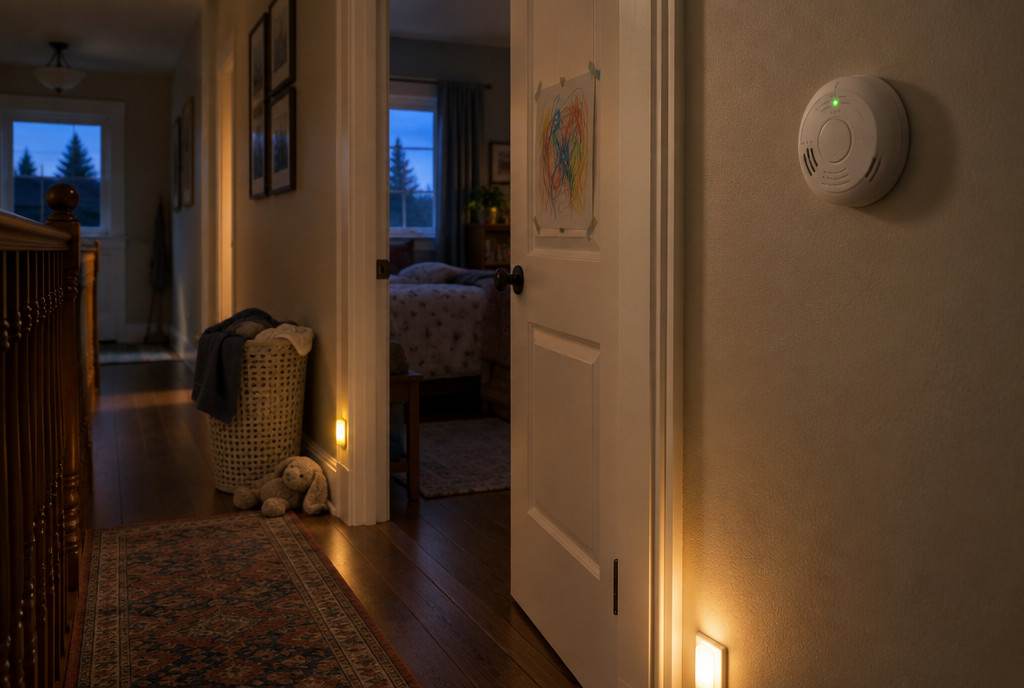
The national advice (NRCan) is one near the furnace or other fuel-burning appliance and one in each bedroom area, where it will wake you. Some provinces ask for more: Ontario, for example, now also requires one on every storey without bedrooms. Use alarms certified to CSA 6.19; combination smoke/CO units count.
-
Check every end-of-life date
Flip each alarm over: the manufacture or replace-by date is printed on the back. Expired or undated (old) units get replaced today, not eventually. Test buttons monthly; batteries when the clocks change.
-
Book annual servicing for fuel appliances
A licensed gas technician (or a WETT-certified sweep for wood) confirms clean burn and clear venting once a year. Most CO incidents trace to blocked vents, cracked heat exchangers or corroded flues, all findable before they matter.
-
Get the spillage check with your energy audit
During the assessment, your advisor checks whether water heater and furnace exhaust spills back into the house under depressurization, the exact condition air sealing and big exhaust fans create. It's included when you have combustion appliances; make sure it happens.
CO alarm rules, province by province
The national advice, wherever you live
NRCan's advice is that every home with a combustion appliance should have CO alarms: typically one near the furnace or other fuel-burning appliance and one in each bedroom area, so the alarm can be heard.
For new houses, the National Building Code 2020 (Article 9.32.3.9) requires a CO alarm inside each bedroom or within 5 m outside each bedroom door when the home has a fuel-burning appliance or an attached garage, an alarm in any room with a solid-fuel-burning appliance (on or near the ceiling unless the maker's instructions say otherwise), and interconnected alarms in a house with a secondary suite.
What each province and territory says about existing homes, as we read the official sources on September 28, 2026. Municipal by-laws can add to these, so ask your local fire service too.
British ColumbiaNot required in existing homes
- Not required in existing homes; the province recommends alarms wherever there's a fuel-burning appliance, a fireplace or an attached garage.
- New homes served by or containing a fuel-burning appliance, or with an attached garage, need CO alarms under the BC Building Code.
AlbertaNot required in existing homes
- Required in new homes with a fuel-burning appliance or an attached garage; for existing homes the province calls them highly recommended.
- Alberta's fire code requires CO alarms that are installed to be inspected, tested and maintained following the manufacturer's instructions.
SaskatchewanRequired in existing homes
- Required in all residential buildings, whatever their age, that contain a fuel-burning appliance, an attached garage or more than one suite (enforced since July 1, 2022).
- In a house, put an alarm inside each bedroom or within 5 m outside each bedroom door, plus one in any room with a solid-fuel-burning appliance such as a wood stove.
- From November 1, 2026, Henry's Law requires a CO alarm in every residential suite, including houses with secondary suites.
ManitobaNot required in existing homes
- The Manitoba Fire Code requires CO detection only in buildings that need regular fire-safety inspections, such as care homes, schools and hotels; private houses aren't on the list.
OntarioRequired in existing homes
- Required in every home with a fuel-burning appliance, a fireplace or an attached garage, and since January 1, 2026 also in homes served by a forced-air fuel-burning appliance located outside the building.
- Put an alarm next to each sleeping area and, since January 1, 2026, on every storey that has no sleeping area.
- Hardwired, battery and plug-in alarms are all allowed.
- The homeowner is responsible in an owner-occupied home, and the landlord in a rental.
QuebecNot required in existing homes
- There's no province-wide rule for houses: municipal by-laws decide, so ask your municipal fire service.
- Provincial rules cover larger buildings (multi-unit buildings of more than 2 storeys and 8 units, rooming houses, hotels and seniors' residences), where units with a combustion appliance or direct access to an indoor parking garage need a CO alarm.
New BrunswickNo rule found for existing homes
- We found no provincial rule requiring CO alarms in existing homes; new construction follows the 2020 National Building Code.
Nova ScotiaNot required in existing homes
- New homes with a fuel-burning appliance or an attached garage need a CO alarm under the building code; older homes don't have to be retrofitted unless a building official or fire inspector orders it.
- Nova Scotia's fire safety rules require CO alarms to be inspected, tested and maintained following the manufacturer's instructions.
Prince Edward IslandNo rule found for existing homes
- We found no rule requiring CO alarms in existing homes; PEI's Fire Marshal advises installing them outside each sleeping area and on every level.
Newfoundland and LabradorNo rule found for existing homes
- The province's fire regulations require smoke alarms in existing homes but contain no CO alarm requirement.
YukonRequired in existing homes
- Every Yukon residence with a fuel-burning appliance or an attached garage must have CO detectors (Government of Yukon).
Northwest TerritoriesNo rule found for existing homes
- We found no territorial requirement for existing homes; the NWT applies the 2020 National Building Code to new construction.
Nunavut, or a rule you can't find here: check your province's or territory's fire code, or ask your local fire department, and follow the national advice above in the meantime.
How to read your result
What the number is: Carbon monoxide in indoor air, read from a CO meter or a low-level CO monitor.Unit: ppm (parts per million)
- BackgroundUnder 9 ppm
What it means: Typical when nothing is leaking; homes without gas stoves usually read 0.5–5 ppm.
What to do: Keep certified CO alarms near bedrooms and have fuel-burning appliances serviced every year.
- CO detected9 to 35 ppm
What it means: Something is adding CO. Health Canada's limits are 10 ppm averaged over 24 hours and 25 ppm over 1 hour.
What to do: Open windows, check stoves, heaters and the attached garage, and have fuel-burning appliances checked by a qualified technician.
- Elevated36 to 69 ppm
What it means: Well above Health Canada's limits; people with heart disease may feel chest pain.
What to do: Open windows and doors, turn off fuel-burning appliances, and get a qualified technician in before using them again.
- Dangerous70 ppm or more, or any alarm sounding
What it means: Headaches, fatigue and nausea become more noticeable; sustained levels above 150–200 ppm can cause collapse and death.
What to do: Get everyone outside to fresh air now and call 911 or the fire department; return only when responders say it's safe.
Health Canada: buy alarms certified to CSA 6.19 and consider one with a digital display for low levels. New homes need an alarm in or within 5 m of each bedroom (NBC 2020).
Where these numbers come from · checked 2026-10-26
- ANSI/BPI-1200-S-2017 Standard Practice for Basic Analysis of Buildings (PDF)
- Health Canada: Residential indoor air quality guideline, carbon monoxide
- Health Canada: Carbon monoxide, preventing exposure (alarms, what to do)
- US EPA: What is the average level of carbon monoxide in homes?
- US CPSC: Carbon monoxide questions and answers
- US CPSC: CO alarm conformance testing to UL 2034 (alarm response times, PDF)
- NRC Codes Canada: National Building Code of Canada 2020 (free PDF via NRC Publications Archive)
Why tightening the house raises the stakes
Older, naturally vented appliances rely on a leaky house for draft. Seal the leaks, the single best energy upgrade, and a bathroom fan, range hood or dryer can pull harder than the chimney, dragging exhaust back inside. This is why the retrofit sequence pairs air sealing with a combustion safety check, and why the cleanest long-term answer is sealed-combustion (direct-vent) equipment or a heat pump, which makes the whole question moot.
Common questions
Is a CO alarm required in my home?
In an existing home, Saskatchewan, Ontario and Yukon require them for homes with a fuel-burning appliance or an attached garage (Saskatchewan's rule covers residential buildings of any age). The National Building Code requires them in new homes with a fuel-burning appliance or an attached garage, and some municipalities add their own by-laws. Where no rule applies, NRCan's advice is the same: every home with a combustion appliance should have CO alarms.
Where exactly do CO alarms have to go?
It depends on your province, but the national advice is the same everywhere: NRCan suggests one near the furnace or other fuel-burning appliance and one in each bedroom area, where it will wake you. Ontario, as one provincial example, requires an alarm next to each sleeping area and, since January 1, 2026, on every storey without one. Follow the manufacturer's height guidance; unlike smoke, CO mixes with air, so wall-outlet height is fine for plug-in models.
My home is all-electric. Do I still need one?
Where CO alarms are required, the rules apply to homes with a fuel-burning appliance, a fireplace or an attached garage (check your province's wording below). A gas water heater, gas range or wood stove counts even if your heat is electric. A truly all-electric home with no garage and no fireplace usually isn't required to have one, but at $40–$80 many owners keep one anyway for portable generators, future appliances and resale.
Why do CO alarms expire?
The electrochemical sensor inside degrades whether or not it ever alarms. Every unit has an end-of-life date, typically 7–10 years from manufacture, after which it may fail silently. Check the date printed on the back of yours today; many homes are running alarms that expired years ago. Newer units chirp an end-of-life warning; older ones just stop protecting you.
What do I do if the alarm sounds?
Treat it as real: get everyone (pets included) outside or to fresh air, call 911 from outside, and don't re-enter until the fire service clears the home. Headache, dizziness and nausea that improve outdoors are classic CO signs. Afterward, have a licensed gas technician find the source before the appliances run again.
Sources
- NRCan, Keeping the Heat In, Section 2: CO alarms near the furnace and in each bedroom area (verified October 2, 2026)
- National Building Code of Canada 2020: CO alarms in new houses (Article 9.32.3.9)
- British Columbia: carbon monoxide alarm rule (read September 28, 2026)
- Alberta: carbon monoxide alarm rule (read September 28, 2026)
- Saskatchewan: carbon monoxide alarm rule (read September 28, 2026)
- Manitoba: carbon monoxide alarm rule (read September 28, 2026)
- Ontario: carbon monoxide alarm rule (read September 28, 2026)
- Quebec: carbon monoxide alarm rule (read September 28, 2026)
- New Brunswick: carbon monoxide alarm rule (read September 28, 2026)
- Nova Scotia: carbon monoxide alarm rule (read September 28, 2026)
- Prince Edward Island: carbon monoxide alarm rule (read September 28, 2026)
- Newfoundland and Labrador: carbon monoxide alarm rule (read September 28, 2026)
- Yukon: carbon monoxide alarm rule (read September 28, 2026)
- Northwest Territories: carbon monoxide alarm rule (read September 28, 2026)
- Ontario example: Ontario Association of Fire Chiefs guide to the Hawkins-Gignac Act (verified October 2, 2026)
Get the spillage check done right
Every registered advisor we match includes combustion safety when you have fuel appliances. The planner puts it in your audit request automatically.