Specialty test guide · verified October 2, 2026
Well water: the test nobody does for you
If your water comes from a private well, nobody is testing it but you. Most provinces make the important half easy: the bacteria test (E. coli and total coliforms) is free in Alberta, Ontario, Prince Edward Island, Newfoundland and Labrador and Yukon, and costs $17.67–$46 at the public labs that charge. The discipline is simply testing regularly, plus a chemistry panel every few years for what bacteria tests can't see.
Bacteria test
Free in AB, ON, PE, NL and YT
Elsewhere
$17.67–$46 at public labs
How often
1–3 times a year
Chemistry panel
Every 1–5 years
The testing routine
-
Get the sample bottles
Sterile bottles come from your provincial or public-health lab or one of its pickup points (in Ontario, a Public Health Ontario lab or your health unit), or from an accredited private lab where there's no public service. The list below shows who tests in your province.
-
Collect the sample properly
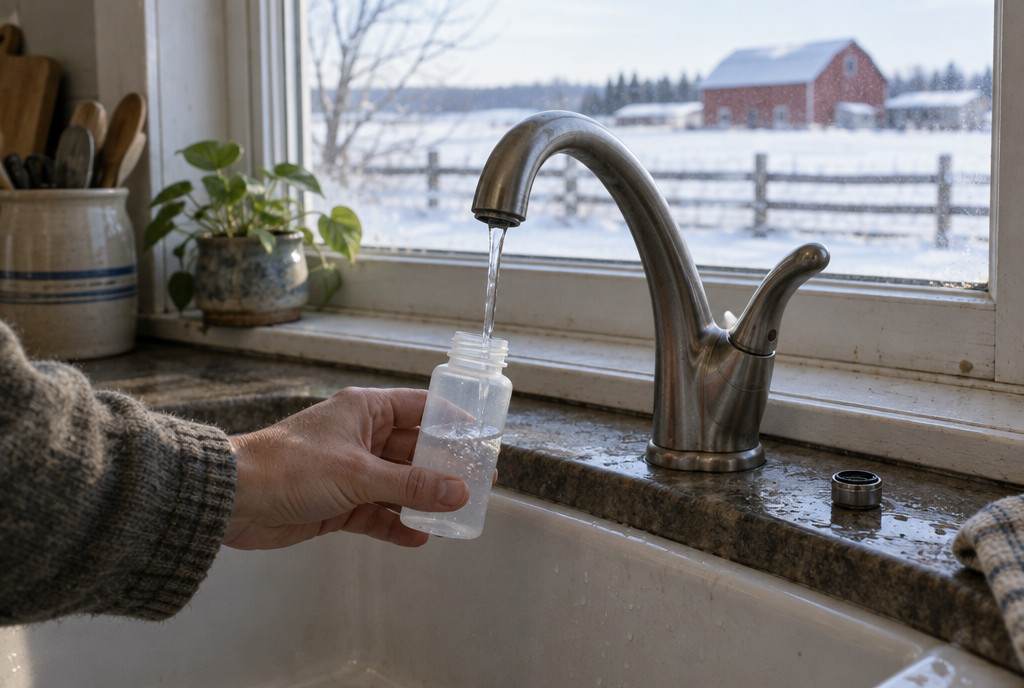
Follow the kit card exactly: a clean tap without an aerator screen if possible, run the cold water a few minutes first, don't rinse the bottle or touch its rim, fill to the line, cap immediately.
-
Get it to the lab fast, kept cool
Bacteria samples have to be tested soon after collection: Public Health Ontario, for example, must test within 48 hours, so it asks for samples within 24. Keep the bottle in the dark at 2–8 °C, in a cooler with ice packs that don't touch it; frozen samples are refused. Check your lab's drop-off days and hours before you collect.
-
Read the result: the target is zero
Safe well water shows no total coliforms and no E. coli. Any detection means investigate: wellhead condition, casing, surface drainage, septic distance. Resample after any fix, and after every spring melt if your well has a history.
-
Every few years, test the chemistry
A lab panel for nitrate, arsenic, uranium, sodium and metals: the bacteria test says nothing about these. Provinces suggest a baseline when the well is drilled or you move in, then every 1 to 5 years, and any time taste, colour or smell changes.
-
Keep every report
A dated file of clean results documents your water the way an EnerGuide label documents your energy: it answers a buyer's hardest rural question before it's asked.
Who tests well water, province by province
Where to send samples, what it costs and how often to test, as we read each official source on September 28, 2026. Fees change, so confirm with the lab before you collect.
British ColumbiaPaid, private lab
There's no free provincial program: use a qualified lab (search the CALA directory), which supplies the bottles. HealthLinkBC recommends testing for bacteria at least once a year and for chemistry when the well is new and annually after that.
AlbertaFree (Alberta Health Services)
Alberta Health Services tests private well water free, for bacteria plus chemistry and trace metals; pick up bottles at AHS facilities. Test for bacteria twice a year and for chemistry every three years.
Saskatchewan$23 bacteria (provincial lab)
The Roy Romanow Provincial Laboratory tests well water for a fee: $23 for bacteria and $29 for a potability panel in its published schedule (confirm current prices). Bottles are at rural municipality and public health offices. Test yearly for bacteria and nitrate.
Manitoba$17.67 bacteria (subsidized)
Manitoba's Private Well Testing Subsidy covers one bacteria test a year for $17.67 at Duracan Laboratory in Winnipeg, with a free re-test after a positive result. Test at least once a year, ideally after snowmelt.
OntarioBacteria free (Public Health Ontario)
Free bacteria testing through Public Health Ontario labs: pick up a kit at a PHO lab or your public health unit and drop it back off. Chemistry (nitrate, sodium, metals) goes to a licensed private lab for a fee. Local health units recommend testing at least three times a year: spring, summer and fall.
QuebecPaid, accredited lab
There's no free provincial service: send samples to a lab accredited by Quebec's environment ministry (the CEAEQ list), which supplies the bottles. The ministry recommends testing for bacteria at least twice a year, in spring and fall, plus a chemical analysis while the well is in use.
New BrunswickPaid (RPC or accredited lab)
Owners pay: test kits are at Service New Brunswick offices or RPC, the designated provincial lab in Fredericton and Moncton. The province recommends testing for bacteria twice a year and for inorganic contaminants every two years.
Nova Scotia$34.50 bacteria (Nova Scotia Health)
Owners pay: Nova Scotia Health charges $34.50 for a bacteria test and $37.63 to $138.77 for chemical packages, with bottles at NSH locations. The province recommends testing for bacteria every year and for chemicals every five years.
Prince Edward IslandFree (bacteria and chemistry)
Free since January 1, 2022: bacteria and general chemistry for residential wells through PEI Analytical Laboratories, with bottles at the lab or any Access PEI site. Test for bacteria yearly and chemistry every two years.
Newfoundland and LabradorBacteria free
Free bacteria testing: sterile bottles are at Government Service Centres and the NL Public Health Laboratory. Chemistry goes to an approved private lab for a fee.
YukonBacteria free
Free bacteria testing at Yukon's Environmental Health Services water lab in Whitehorse (867-667-8391). No Yukon lab tests chemistry, so those samples go to accredited labs in B.C. or Alberta, often around $200 plus shipping.
Northwest Territories$28 bacteria (Taiga lab)
There's no free program: the GNWT's Taiga Environmental Laboratory in Yellowknife tests private samples ($28 for bacteria in its 2021 price guide) and supplies bottles free.
Nunavut, or a province whose page has changed: check your provincial or territorial health or environment department for the current lab and fees, and follow the routine above.
How to read your result
What the number is: Lab results for bacteria (total coliforms, E. coli) and nitrate in a water sample from your well.Unit: Present/absent per 100 mL (bacteria) · mg/L (nitrate)
- ClearNo E. coli and no total coliforms per 100 mL; nitrate at or under 10 mg/L as N (45 as nitrate)
What it means: Meets Health Canada's guidelines for these tests on the day sampled.
What to do: Keep testing on schedule and after floods, heavy rain, well work or changes in taste, smell or appearance.
- Coliforms foundTotal coliforms present, E. coli absent
What it means: Soil or surface water may be reaching the well, so disease-causing germs are possible.
What to do: Retest soon; if confirmed, shock-disinfect the well, find the entry point, and retest until two samples are clear.
- E. coli foundAny E. coli
What it means: Fecal contamination: the water is not safe to drink.
What to do: Boil water for drinking, cooking and brushing teeth (1-minute rolling boil) or use another source; retest and disinfect the well.
- Nitrate highOver 10 mg/L as nitrate-N (over 45 mg/L as nitrate)
What it means: Above Health Canada's health limit; most dangerous for babies under 6 months (blue baby syndrome).
What to do: Use another safe source for drinking and infant formula; treat with certified reverse osmosis or distillation, then retest.
Health Canada: test for bacteria at least every 6 months (early spring and fall are best) and general quality every 2 years. If only coliforms appear, you can keep using the water while retesting.
Where these numbers come from · checked 2026-10-26
- Health Canada: Well water, test your well water
- Health Canada: Well water, treat your well water
- Health Canada: Guidelines for Canadian Drinking Water Quality, summary tables
- US EPA: Protect your home's water (private well testing)
- US EPA: National Primary Drinking Water Regulations (nitrate, coliforms)
The rural audit connection
Rural retrofits touch the well more than you'd think: the pump is part of your electrical baseload (it shows up in the planner's bill analysis), trenching and grading work near the wellhead can change surface drainage, and a heat pump conversion that frees you from fuel deliveries pairs naturally with getting the water file in order. If you told the planner you're on a well, this test is already in your audit request.
Common questions
How often should I test?
Provincial advice ranges from once a year (British Columbia, Saskatchewan, Manitoba, Nova Scotia, Prince Edward Island and Yukon) to twice a year (Alberta, Quebec and New Brunswick) and three times in Ontario, where local health units suggest spring, summer and fall. Test after spring snowmelt and heavy rain, when contamination is most likely to get in, and more often for shallow or older dug wells. Where the bacteria test is free, frequency costs you only the trip to a drop-off.
My result came back positive for coliforms. Now what?
Stop drinking it untreated (boil it or use bottled water), resample to rule out a collection error, and look for the cause: a damaged or unsealed well cap, casing cracks, surface water pooling at the wellhead, or a nearby septic problem. Shock chlorination plus repairs often clears it; then retest until you have consecutive clean results. Your provincial health or environment office will walk you through it (in Ontario, your local public health unit).
Do I need the paid chemistry tests too?
Periodically, yes. A bacteria test says nothing about nitrate (a concern near farmland), arsenic or uranium (from bedrock), sodium, fluoride or metals. Alberta and Prince Edward Island test chemistry free; elsewhere it goes to an accredited lab, about $104–$200 for a full panel at the public-lab prices we found. Provinces suggest a baseline when the well is drilled or you move in, then every 1 to 5 years, and any time taste, colour or smell changes.
Buying a rural home: what should I ask for?
Test before closing (make it a condition), and ask the sellers for their testing history: a documented record of clean results is worth real money, and its absence is worth a question. Include a chemistry panel, not just the bacteria test, plus a well record: depth, age, casing and the flow test. Our planner folds the well test into your audit request automatically for rural homes.
Sources
- British Columbia: private well water testing (read September 28, 2026)
- Alberta: private well water testing (read September 28, 2026)
- Saskatchewan: private well water testing (read September 28, 2026)
- Manitoba: private well water testing (read September 28, 2026)
- Ontario: private well water testing (read September 28, 2026)
- Quebec: private well water testing (read September 28, 2026)
- New Brunswick: private well water testing (read September 28, 2026)
- Nova Scotia: private well water testing (read September 28, 2026)
- Prince Edward Island: private well water testing (read September 28, 2026)
- Newfoundland and Labrador: private well water testing (read September 28, 2026)
- Yukon: private well water testing (read September 28, 2026)
- Northwest Territories: private well water testing (read September 28, 2026)
- Ontario example: Public Health Ontario, drinking water testing for private citizens (48-hour rule, 2–8 °C storage) (verified October 2, 2026)
- Ontario example: Public Health Ontario, well water testing (verified October 2, 2026)
Lab fees: Published fees: Manitoba subsidized $17.67; Saskatchewan RRPL $23 (2017 schedule); NWT Taiga $28 (2021); Nova Scotia Health $34.50 presence-absence, $46.00 MPN. Free in ON, AB, PE, NL and YT. Saskatchewan general chemistry $104 (2017); Nova Scotia Health packages C/D $120.67-$138.77 (D with bacteria $198.49); Yukon 'often as much as $200 plus shipping'. Outlier: Taiga (NWT) annual drinking-water package $380 (2021).
Rural home, full picture
Tell us where you are and we'll match you with an advisor who covers the whole rural checklist: envelope, heating, radon and the well.