How Saguenay is built
- Before 1961 26%
- 1961–1990 49%
- 1991–2000 9%
- 2001 or later 16%
Why air leakage matters in Saguenay
Saguenay gets about 5,343 heating degree-days a year, a measure of how much heating its climate needs, and its winter design temperature, the cold day heating systems are sized for, is −28.9°C. Those figures come from the climate data for Jonquière in HOT2000, the home-energy software Natural Resources Canada (NRCan) gives energy advisors. That's the 10th-highest heating demand of the 70 cities we cover. Cold winters: heating is the biggest energy cost, so stopping leaks and insulating come first.
Saguenay also gets hot spells and heat waves, so plan how the house will stay cool: air sealing, attic insulation and shading help, and a heat pump adds efficient cooling.
Of Saguenay's 48,955 houses (single-detached, semi-detached, row houses and duplexes), 26% were built before 1961 and 75% before 1991, according to the 2021 Census. Older houses usually test leakier than newer ones, and an EnerGuide report compares your result with homes of the same era, so you can see whether your house is typical or a problem.
After you seal: two checks
- Radon. Sealing shifts the pressure balance between the house and the soil. Health Canada's 2012 survey found 2.8% of 72 homes tested in the Région du Saguenay - Lac-Saint-Jean health region above the guideline. The larger 2024 Cross-Canada survey reports 16.7% (1 in 6) at or above the guideline for Quebec. Test before and after big air-sealing jobs. Radon testing in Saguenay
What it costs in Saguenay
A blower door test is part of every EnerGuide evaluation rather than a separate purchase. In Quebec, EnerGuide evaluations are booked through the provincial Rénoclimat program: the pre-retrofit evaluation costs $150 plus taxes, reimbursed when you receive financial assistance under the program, and the first post-retrofit evaluation is free.
How the test works
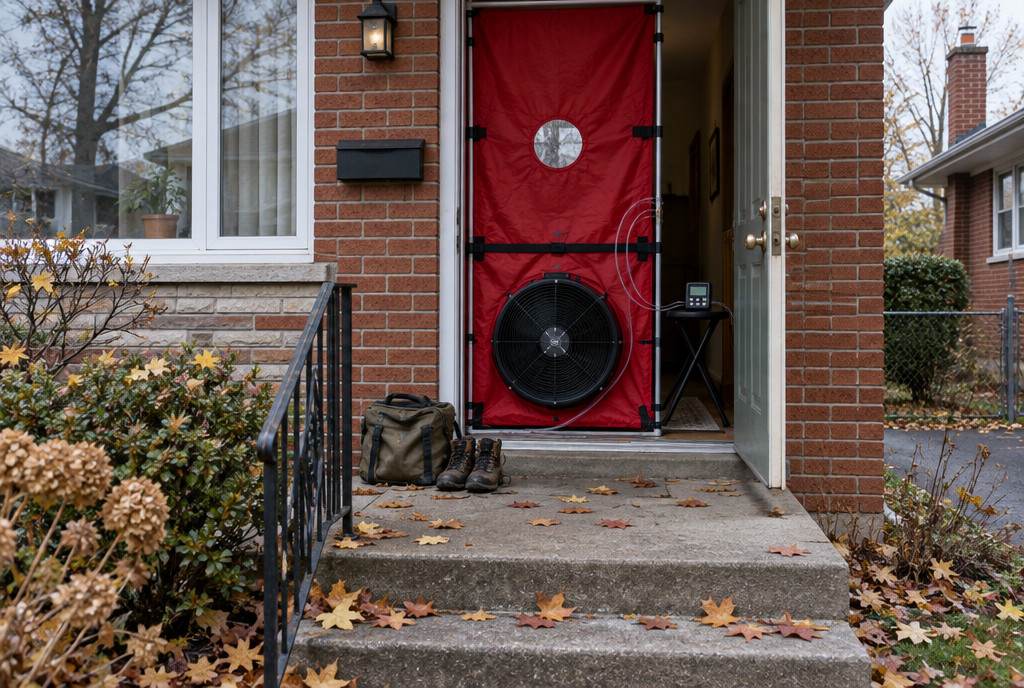
- A calibrated fan is fitted into an exterior door and pulls air out until the house is at 50 pascals, the standard test pressure.
- The result is air changes per hour at 50 Pa (ACH50): how many times an hour the whole volume of air would leak out and be replaced at that pressure.
- While the fan runs, you and the advisor walk the house and feel for leaks at the attic hatch, rim joists, pot lights, trim and plumbing and wiring penetrations.
- A second test after the work shows what changed, and it is what most rebates pay on.
Very Cold East Northern Ontario, Saguenay, Quebec City
What this means in Saguenay’s climate
Deep, snowy winters: stop ice dams, and pair a cold-climate heat pump with backup heat.
Why it matters here: Finds the attic and rim joist leaks that feed ice dams.
Best timing: Any season; most useful with a thermal scan in winter.
- Stop ice dams at the attic. NRCan says the best way to prevent ice dams is sealing attic air leaks and insulating thoroughly, so roof snow stays frozen. Snow loads here are the heaviest of any region we cover. Ask: Ask the advisor to trace attic bypasses with the blower door and thermal camera, and to check insulation depth.
- Insulate the basement and rim joists. Basements can be about 20% of a home's heat loss, and the long cold season makes the savings add up. Rim joists are often among the leakiest spots. Ask: Ask whether the basement is dry enough to insulate from inside, and how much the rim joist leaks.
What else homes in Saguenay need →
Sources for this climate guide · checked October 26, 2026
- National Building Code of Canada 2020, climate data (NRC)
- Canadian Climate Normals 1991–2020 (ECCC)
- Keeping the Heat In (NRCan)
- Air-Source Heat Pump Sizing and Selection Guide (NRCan)
- Heating and Cooling With a Heat Pump (NRCan)
- Heat pumps, Canada Greener Homes (NRCan)
- Heat pump basics (NRCan)
- Primary heating systems by household, Table 38-10-0286-01 (Statistics Canada)
- 2024 Cross-Canada Survey of Radon Exposure
- Guide for Radon Measurements in Homes (Health Canada)
- Canada's top weather stories of 2023 (ECCC)
- Conditions for thermal scans, ASTM C1060 summary (Cx Associates)
NRCan-licensed service organizations serving Saguenay
In Quebec, EnerGuide evaluations for existing homes run through the provincial Rénoclimat program; the organizations below are the ones NRCan lists for Saguenay postal codes.
A service organization is a company that Natural Resources Canada (NRCan) licenses to deliver EnerGuide evaluations; its registered energy advisors do the home visit. A blower door test is part of every EnerGuide evaluation, so any organization below can do one in Saguenay. Ask to walk the house with the advisor while the fan runs.
- Expertbâtiment Services-Conseils
- Expertise en batiment Champagne
- Inspection Immotech
Blower door test in Saguenay: common questions
Where can I get a blower door test in Saguenay?
Book an EnerGuide evaluation with any of the 3 NRCan-licensed organizations serving Saguenay; the blower door test is part of every evaluation.
How much does a blower door test cost in Saguenay?
It is included in an EnerGuide evaluation. In Quebec, EnerGuide evaluations are booked through the provincial Rénoclimat program: the pre-retrofit evaluation costs $150 plus taxes, reimbursed when you receive financial assistance under the program, and the first post-retrofit evaluation is free.
What is a good blower door result?
Lower is better. Your EnerGuide report compares your air changes per hour at 50 Pa with homes of the same era, which is more useful than a single target number.
Does air sealing affect radon?
It can. Tightening a house changes the pressure difference with the soil, so test for radon before and after major air sealing.