How Burlington is built
- Before 1961 15%
- 1961–1990 48%
- 1991–2000 15%
- 2001 or later 22%
Why it matters in Burlington
In the Hamilton area, 75% of households heat mainly with a forced-air furnace; natural gas is the main heating energy for 65% of households and electricity for 20% (Statistics Canada, 2023).
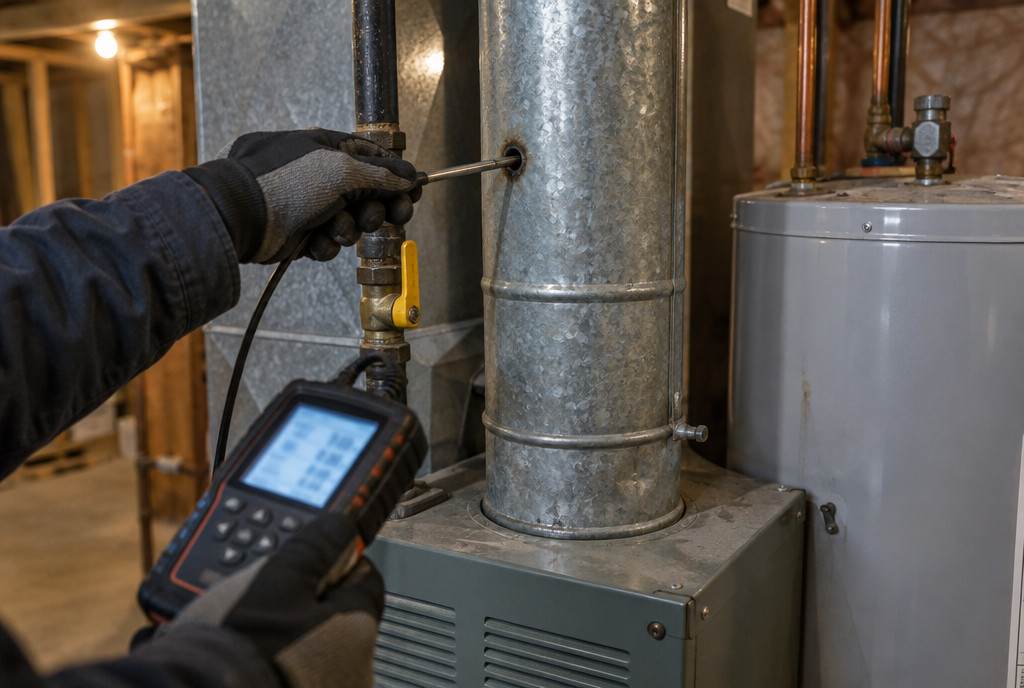
The risk rises after air sealing: a tighter house plus a strong exhaust fan or dryer can pull exhaust back down a chimney. That's why advisors test for spillage during an evaluation and why it should be repeated after serious tightening.
The CO alarm rule in Ontario
Ontario's Fire Code requires CO alarms in existing homes that have a fuel-burning appliance, a fireplace or an attached garage: next to every sleeping area and, since January 1, 2026, on every storey as well.
What the check involves
- Worst-case depressurization: exhaust fans and the dryer on, doors set to make the appliance room as negative as it gets.
- A spillage and draft check at each appliance, with a CO reading.
- A plan if anything fails: often a sealed-combustion appliance or a fix to the venting, done by a licensed gas or oil technician.
Great Lakes–St. Lawrence Southern Ontario and southern Quebec
What this means in Burlington’s climate
Cold winters and hot, humid summers: seal the attic, dry the basement, plan cooling.
Why it matters here: In gas-heated homes, tightening can cause spillage from older furnaces and water heaters.
Best timing: During the blower door visit.
What else homes in Burlington need →
Sources for this climate guide · checked October 26, 2026
- National Building Code of Canada 2020, climate data (NRC)
- Canadian Climate Normals 1991–2020 (ECCC)
- Keeping the Heat In (NRCan)
- Air-Source Heat Pump Sizing and Selection Guide (NRCan)
- Heating and Cooling With a Heat Pump (NRCan)
- Heat pump basics (NRCan)
- Gas and heat pump hybrid systems (NRCan)
- Primary heating systems by household, Table 38-10-0286-01 (Statistics Canada)
- Electricity price comparison, April 2025 (Hydro-Québec)
- Canada's top weather stories of 2018 (ECCC)
- Canada's top weather stories of 2022 (ECCC)
- Canada's top weather stories of 2023 (ECCC)
- Canada's most impactful weather stories of 2024 (ECCC)
- Canada's top weather stories of 2025 (ECCC)
- 2024 Cross-Canada Survey of Radon Exposure
- Guide for Radon Measurements in Homes (Health Canada)
- Conditions for thermal scans, ASTM C1060 summary (Cx Associates)
NRCan-licensed service organizations serving Burlington
A service organization is a company that Natural Resources Canada (NRCan) licenses to deliver EnerGuide evaluations; its registered energy advisors do the home visit. Energy advisors check for combustion spillage during an evaluation; fixing a venting problem is work for a licensed gas or oil technician.
Only assessments from the seven HRSP-approved organizations qualify for the $600 Home Renovation Savings rebate and its assessment-path upgrade rebates; each listing below says whether it's one of them.
- Acacia Engineering HRSP-approved: No
- Air Barrier Canada HRSP-approved: No
- All Season Inspection HRSP-approved: No Profile
- AmeriSpec HRSP-approved: Yes Profile
- BEST Energy and Sustainability HRSP-approved: No
- CoEfficient Building Science HRSP-approved: No
- ecoGEO Energy HRSP-approved: No
- EcoLogic Energy Advisors HRSP-approved: No
- Ecostep Energy Services HRSP-approved: No
- Energy Werx HRSP-approved: Yes Profile
- EnerQuality HRSP-approved: No
- EnerSolution HRSP-approved: No Profile
- Engreen Home HRSP-approved: No
- ER Energy Solutions HRSP-approved: No
- GETS Energy HRSP-approved: No
- Green Canada Home Advisors HRSP-approved: No Profile
- Greenbrain HRSP-approved: Yes Profile
- Sensible Home Inspections HRSP-approved: No
- Verdatech Energy Management and Consulting HRSP-approved: No
- Windfall Ecology Centre HRSP-approved: No Non-profit network Profile
- Enerhold Engineering Solutions HRSP-approved: No
- The Energuy HRSP-approved: Yes Profile
- Clean Energy Solutions HRSP-approved: No
Programs in Burlington
Combustion safety test in Burlington: common questions
Are CO alarms required in Burlington homes?
Ontario's Fire Code requires CO alarms in existing homes that have a fuel-burning appliance, a fireplace or an attached garage: next to every sleeping area and, since January 1, 2026, on every storey as well.
Who does combustion safety testing?
Energy advisors check for spillage during an EnerGuide evaluation. Repairs to venting or appliances are done by a licensed gas or oil technician.
I have CO alarms. Isn't that enough?
Alarms warn you once CO is already in the house. A spillage test finds a venting problem before it produces CO.