How Saanich is built
- Before 1961 28%
- 1961–1990 50%
- 1991–2000 11%
- 2001 or later 11%
Why it matters in Saanich
In the Victoria area, 37% of households heat mainly with electric baseboards, 23% with a heat pump and about 16% with a forced-air furnace; electricity is the main heating energy for 46% of households and natural gas for 23% (Statistics Canada, 2023).
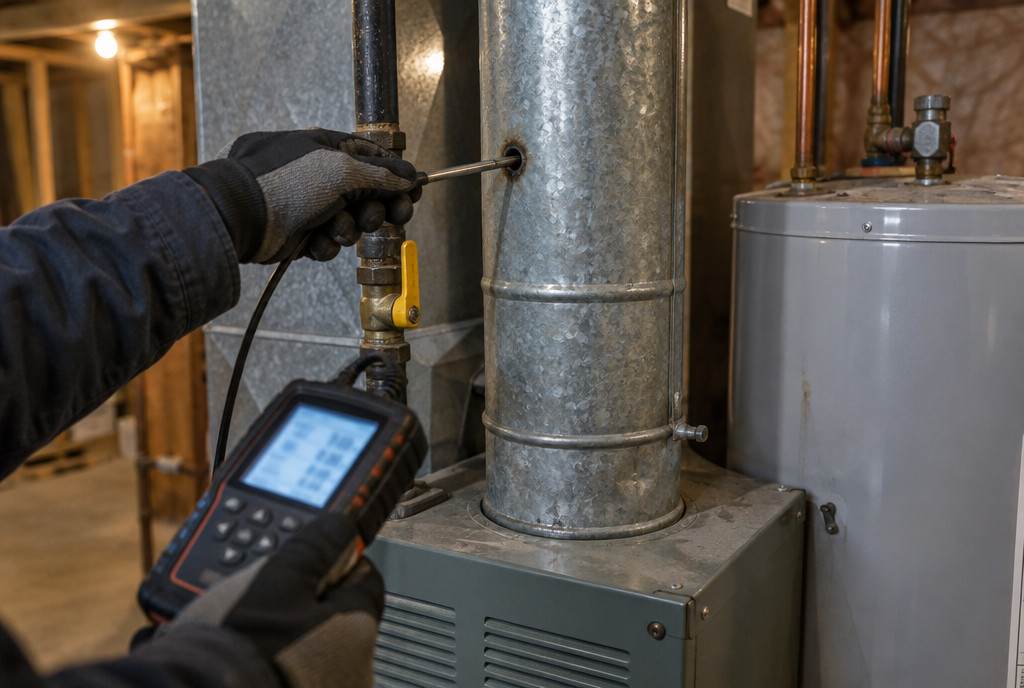
The risk rises after air sealing: a tighter house plus a strong exhaust fan or dryer can pull exhaust back down a chimney. That's why advisors test for spillage during an evaluation and why it should be repeated after serious tightening.
The CO alarm rule in British Columbia
B.C. doesn't require CO alarms in existing homes; the province recommends them wherever there's a fuel-burning appliance, fireplace or attached garage, and the building code requires them in new homes.
What the check involves
- Worst-case depressurization: exhaust fans and the dryer on, doors set to make the appliance room as negative as it gets.
- A spillage and draft check at each appliance, with a CO reading.
- A plan if anything fails: often a sealed-combustion appliance or a fix to the venting, done by a licensed gas or oil technician.
Coastal BC Lower Mainland and Vancouver Island
What this means in Saanich’s climate
Mild, wet winters and summer heat waves: fix moisture first, then cooling and heat pumps.
Coastal BC has Canada's mildest winters, but heavy rain from fall to spring soaks walls and roofs, and summer heat waves are now a health risk. Heating needs are the lowest of any region we cover, so damp, drafts and overheating are the common complaints. An EnerGuide evaluation here should look for moisture problems before any air sealing or insulation, then plan a heat pump that heats and cools.
- Add ventilation as you tighten. A tighter house in a damp climate needs fans or an HRV to keep winter humidity down. Without them, condensation and mould can follow, and gas appliances risk backdrafting. Ask: Ask for a ventilation assessment, and a combustion safety test if you have a gas furnace, boiler, water heater or fireplace.
What else homes in Saanich need →
Sources for this climate guide · checked October 26, 2026
- National Building Code of Canada 2020, climate data (NRC)
- Canadian Climate Normals 1991–2020 (ECCC)
- Keeping the Heat In (NRCan)
- Air-Source Heat Pump Sizing and Selection Guide (NRCan)
- Heat pump basics (NRCan)
- Heating and Cooling With a Heat Pump (NRCan)
- Primary heating systems by household, Table 38-10-0286-01 (Statistics Canada)
- Electricity price comparison, April 2025 (Hydro-Québec)
- BC Coroners Service review of 2021 heat deaths
- Wildfire smoke, filtration and cooling (Island Health)
- Wildfire smoke: protecting your health (Government of Canada)
- Canada's top weather stories of 2020 (ECCC)
- Canada's most impactful weather stories of 2024 (ECCC)
- 2024 Cross-Canada Survey of Radon Exposure
- Guide for Radon Measurements in Homes (Health Canada)
- Conditions for thermal scans, ASTM C1060 summary (Cx Associates)
- Canada's top weather stories of 2022 (ECCC)
NRCan-licensed service organizations serving Saanich
A service organization is a company that Natural Resources Canada (NRCan) licenses to deliver EnerGuide evaluations; its registered energy advisors do the home visit. Energy advisors check for combustion spillage during an evaluation; fixing a venting problem is work for a licensed gas or oil technician.
- Acacia Engineering
- Canada Energy Audit Profile
- Capital Home Energy
- City Green Solutions
- CoEfficient Building Science
- DW Energy Advisors
- Energy Werx Profile
- Enerhold Engineering Solutions
- Enerhome Consulting
- EnerSolution Profile
- EnerTech Solutions
- ER Energy Solutions
- GETS Energy
- Green Canada Home Advisors Profile
- Green Think
- Greenbrain Profile
- HomeTech Energy Solutions
- Isle Energy Consulting
- NRGwise (A1 NRGwise Consulting) Profile
- Sensible Home Inspections
- The Energuy Profile
- VerdaTech Energy Management and Consulting
Programs in Saanich
Combustion safety test in Saanich: common questions
Are CO alarms required in Saanich homes?
B.C. doesn't require CO alarms in existing homes; the province recommends them wherever there's a fuel-burning appliance, fireplace or attached garage, and the building code requires them in new homes.
Who does combustion safety testing?
Energy advisors check for spillage during an EnerGuide evaluation. Repairs to venting or appliances are done by a licensed gas or oil technician.
I have CO alarms. Isn't that enough?
Alarms warn you once CO is already in the house. A spillage test finds a venting problem before it produces CO.