How Ottawa is built
- Before 1961 16%
- 1961–1990 40%
- 1991–2000 13%
- 2001 or later 32%
Who needs it in Ottawa
In the Ottawa (Ontario) part of the Ottawa–Gatineau region, 69% of households heat mainly with a forced-air furnace, 10% with electric baseboards and about 6% with a boiler and radiators; natural gas is the main heating energy for 59% of households and electricity for 21% (Statistics Canada, 2023).
Of Ottawa's 287,345 houses (single-detached, semi-detached, row houses and duplexes), 16% were built before 1961 and 56% before 1991, according to the 2021 Census. Ducts in older houses often run through unheated spaces with taped or unsealed joints, and supply runs to the far rooms are the first to suffer.
The same leaks cost you in summer when the ducts carry cooling: air from a central air conditioner or heat pump that escapes into an attic, garage or crawlspace is cooling you paid for, and leaky return ducts can pull in humid air. Sealing and balancing the ducts helps in both seasons, and it's worth doing before a new heat pump goes onto old ductwork.
What the test shows
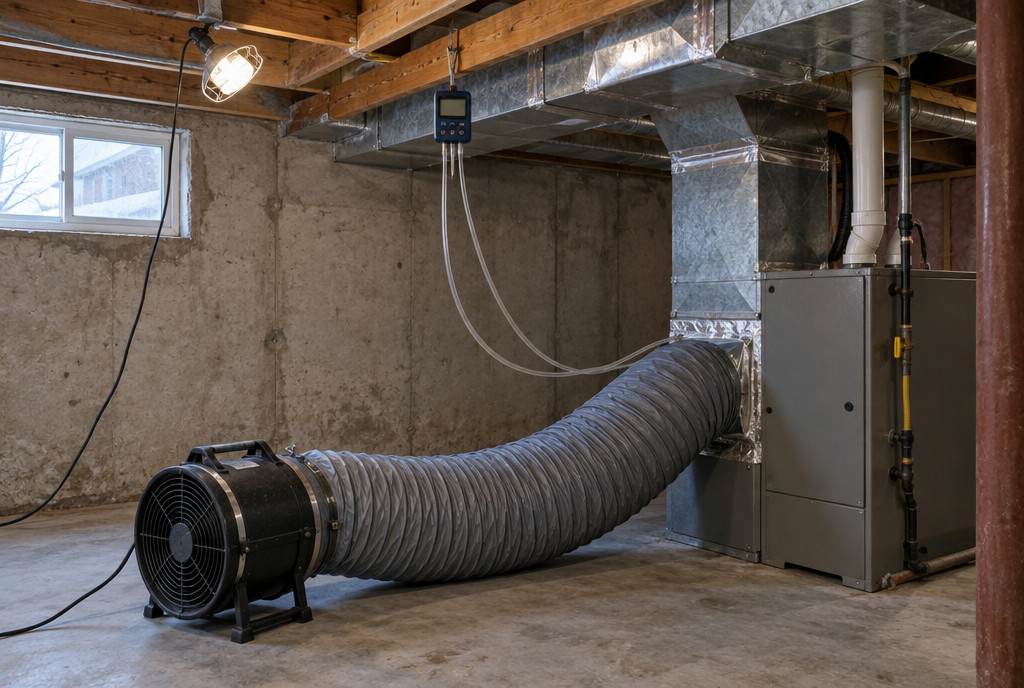
- Total duct leakage, as a share of the system's airflow, measured by pressure-testing the ductwork with a calibrated duct-pressurization fan.
- Airflow at each register, which explains why one bedroom is always cold.
- Whether sealing and balancing will fix comfort problems before you buy bigger equipment.
What it costs
About $200–$450 (a September 2026 planning range; quotes vary). It isn't part of a standard EnerGuide evaluation, so ask for it when you book if comfort is your main complaint.
Great Lakes–St. Lawrence Southern Ontario and southern Quebec
What this means in Ottawa’s climate
Cold winters and hot, humid summers: seal the attic, dry the basement, plan cooling.
This region has real winters and hot, humid summers, so bills come from both heating and cooling. Natural gas heats most Ontario homes, while most Quebec homes use low-cost electricity. An EnerGuide evaluation here should cover air sealing and the attic, cooling and dehumidification, and keeping the basement dry before insulating it.
- Right-size cooling to control humidity. In humid summers, an oversized air conditioner or heat pump cools quickly but shuts off before removing moisture, leaving rooms clammy. A heat pump replacing the air conditioner also covers much of the heating. Ask: Ask for a room-by-room heat-loss calculation and a duct and airflow check before replacing your air conditioner or furnace.
What else homes in Ottawa need →
Sources for this climate guide · checked October 26, 2026
- National Building Code of Canada 2020, climate data (NRC)
- Canadian Climate Normals 1991–2020 (ECCC)
- Keeping the Heat In (NRCan)
- Air-Source Heat Pump Sizing and Selection Guide (NRCan)
- Heating and Cooling With a Heat Pump (NRCan)
- Heat pump basics (NRCan)
- Gas and heat pump hybrid systems (NRCan)
- Primary heating systems by household, Table 38-10-0286-01 (Statistics Canada)
- Electricity price comparison, April 2025 (Hydro-Québec)
- Canada's top weather stories of 2018 (ECCC)
- Canada's top weather stories of 2022 (ECCC)
- Canada's top weather stories of 2023 (ECCC)
- Canada's most impactful weather stories of 2024 (ECCC)
- Canada's top weather stories of 2025 (ECCC)
- 2024 Cross-Canada Survey of Radon Exposure
- Guide for Radon Measurements in Homes (Health Canada)
- Conditions for thermal scans, ASTM C1060 summary (Cx Associates)
Communities served
Ottawa's page covers the whole City of Ottawa, including Richmond.
The organizations and professionals listed for Ottawa may or may not travel to every community, so ask when you call.
NRCan-licensed service organizations serving Ottawa
A service organization is a company that Natural Resources Canada (NRCan) licenses to deliver EnerGuide evaluations; its registered energy advisors do the home visit. Duct leakage testing isn't part of a standard EnerGuide evaluation. Some of these organizations offer it, as do HVAC contractors with duct-testing equipment, so ask when you call.
Only assessments from the seven HRSP-approved organizations qualify for the $600 Home Renovation Savings rebate and its assessment-path upgrade rebates; each listing below says whether it's one of them.
- AmeriSpec HRSP-approved: Yes Profile
- Clean Energy Solutions HRSP-approved: No
- Eco Advantage Energy Advisors HRSP-approved: No
- ecoPlus Services HRSP-approved: No
- Ecostep Energy Services HRSP-approved: No
- Energy Werx HRSP-approved: Yes Profile
- ENERGY3R HRSP-approved: No
- EnerQuality HRSP-approved: No
- EnerSolution HRSP-approved: No Profile
- EnviroCentre HRSP-approved: No
- Green Think HRSP-approved: No
- Greenbrain HRSP-approved: Yes Profile
- Habite-Co 2000 HRSP-approved: No
- Homesol Building Solutions HRSP-approved: No
- The Energuy HRSP-approved: Yes Profile
- Verdatech Energy Management and Consulting HRSP-approved: No
- ER Energy Solutions HRSP-approved: No
- All Season Inspection HRSP-approved: No Profile
- Buildingexpert HRSP-approved: No
- Green Canada Home Advisors HRSP-approved: No Profile
- Sensible Home Inspections HRSP-approved: No
- BEST Energy and Sustainability HRSP-approved: No
- Enerhold Engineering Solutions HRSP-approved: No
Programs in Ottawa
Duct leakage testing in Ottawa: common questions
How much does duct leakage testing cost in Ottawa?
Plan on about $200–$450. It is usually a separate service from an EnerGuide evaluation.
Is duct cleaning the same thing?
No. Cleaning removes dust; it doesn't find or seal leaks. A leakage test measures where air is lost.
What is ductwork pressure testing?
The same thing as a duct leakage test: registers are sealed, a calibrated fan pressurizes the ducts, and the airflow needed to hold the test pressure shows how leaky they are.
Should I close vents in unused rooms?
Usually not. Closing registers raises duct pressure and can increase leakage elsewhere in the system.