How Red Deer is built
- Before 1961 8%
- 1961–1990 39%
- 1991–2000 14%
- 2001 or later 40%
The rule in Alberta
Alberta requires CO alarms in new homes with a fuel-burning appliance or attached garage; for existing homes the province calls them highly recommended rather than mandatory.
Where CO alarms go: installation rules in Alberta
What the rules say about installing alarms:
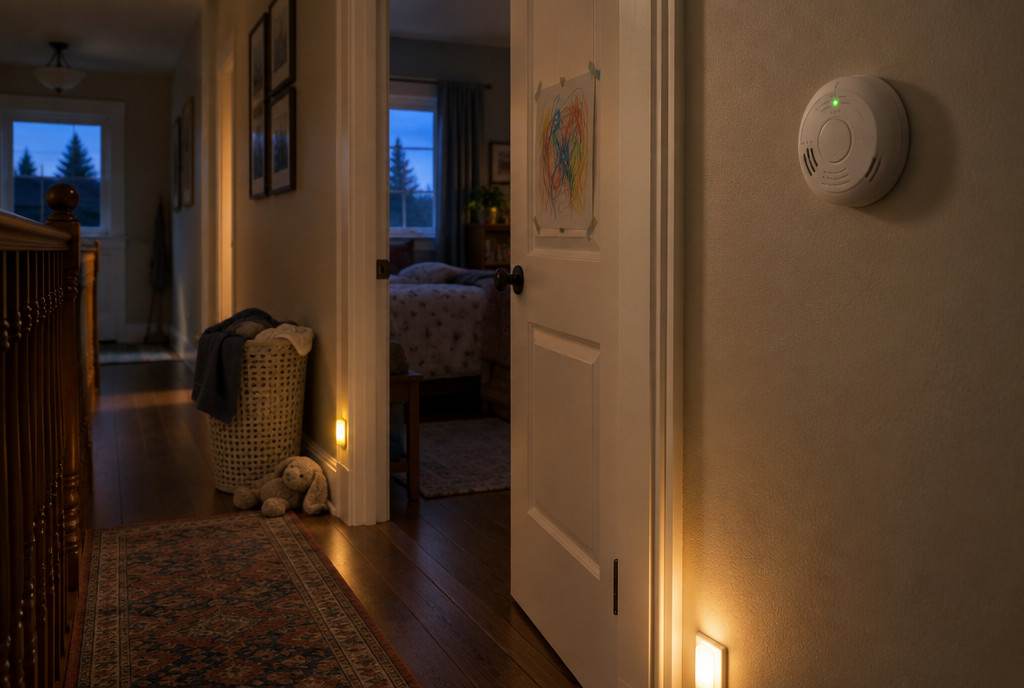
- Required in new homes with a fuel-burning appliance or an attached garage; for existing homes the province calls them highly recommended.
- Alberta's fire code requires CO alarms that are installed to be inspected, tested and maintained following the manufacturer's instructions.
- For new houses, the National Building Code 2020 (Article 9.32.3.9) requires a CO alarm inside each bedroom or within 5 m outside each bedroom door when the home has a fuel-burning appliance or an attached garage, an alarm in any room with a solid-fuel-burning appliance (on or near the ceiling unless the maker's instructions say otherwise), and interconnected alarms in a house with a secondary suite.
CO sources in Red Deer homes
In the Red Deer area, the main heating energy is natural gas for 83% of households (Statistics Canada, 2023). Any fuel-burning appliance, fireplace or attached garage is a potential CO source.
Single-detached houses make up 53% of Red Deer's households; many have an attached garage, another reason to put an alarm near the door into the house.
What a CO check involves
- Alarms next to sleeping areas and on every storey, tested monthly and replaced by their end-of-life date (usually 7 to 10 years).
- Annual service of fuel-burning appliances by a licensed technician.
- A combustion spillage test during an energy evaluation, which catches a venting problem before it produces CO.
Our carbon monoxide guide · Combustion safety testing in Red Deer
Prairies Alberta, Saskatchewan and Manitoba
What this means in Red Deer’s climate
Long, very cold, very dry winters: air sealing, radon testing and humidity balance lead.
Heating is the big bill here: winters are long and very dry, and cold snaps reach −30°C to −35°C. Radon is common, and electricity prices vary widely between provinces, which changes what pays back. An EnerGuide evaluation should focus on air sealing, attic and basement insulation, a radon test and safe humidity levels.
- Check gas appliances after tightening. Most homes here burn natural gas. Air sealing can depressurize the house and pull exhaust back inside, so appliances need a combustion safety test and working CO alarms. Ask: Ask for a combustion safety test during the blower door visit, and again after air sealing.
What else homes in Red Deer need →
Sources for this climate guide · checked October 26, 2026
- National Building Code of Canada 2020, climate data (NRC)
- Canadian Climate Normals 1991–2020 (ECCC)
- Keeping the Heat In (NRCan)
- Air-Source Heat Pump Sizing and Selection Guide (NRCan)
- Heating and Cooling With a Heat Pump (NRCan)
- Heat pumps, Canada Greener Homes (NRCan)
- Gas and heat pump hybrid systems (NRCan)
- Primary heating systems by household, Table 38-10-0286-01 (Statistics Canada)
- Electricity price comparison, April 2025 (Hydro-Québec)
- 2024 Cross-Canada Survey of Radon Exposure
- Guide for Radon Measurements in Homes (Health Canada)
- Canada's top weather stories of 2021 (ECCC)
- Canada's most impactful weather stories of 2024 (ECCC)
- Canada's top weather stories of 2025 (ECCC)
- Conditions for thermal scans, ASTM C1060 summary (Cx Associates)
- Canada's top weather stories of 2022 (ECCC)
Carbon monoxide testing in Red Deer: common questions
Are carbon monoxide alarms mandatory in Red Deer?
Alberta requires CO alarms in new homes with a fuel-burning appliance or attached garage; for existing homes the province calls them highly recommended rather than mandatory.
Where should CO alarms go in Alberta?
Required in new homes with a fuel-burning appliance or an attached garage; for existing homes the province calls them highly recommended. Alberta's fire code requires CO alarms that are installed to be inspected, tested and maintained following the manufacturer's instructions. For new houses, the National Building Code 2020 (Article 9.32.3.9) requires a CO alarm inside each bedroom or within 5 m outside each bedroom door when the home has a fuel-burning appliance or an attached garage, an alarm in any room with a solid-fuel-burning appliance (on or near the ceiling unless the maker's instructions say otherwise), and interconnected alarms in a house with a secondary suite.
How long do CO alarms last?
Most have an end-of-life date of 7 to 10 years printed on the unit; replace them by then even if they still beep when tested.