How Victoria is built
- Before 1961 59%
- 1961–1990 25%
- 1991–2000 6%
- 2001 or later 11%
What an evaluation finds in Victoria homes
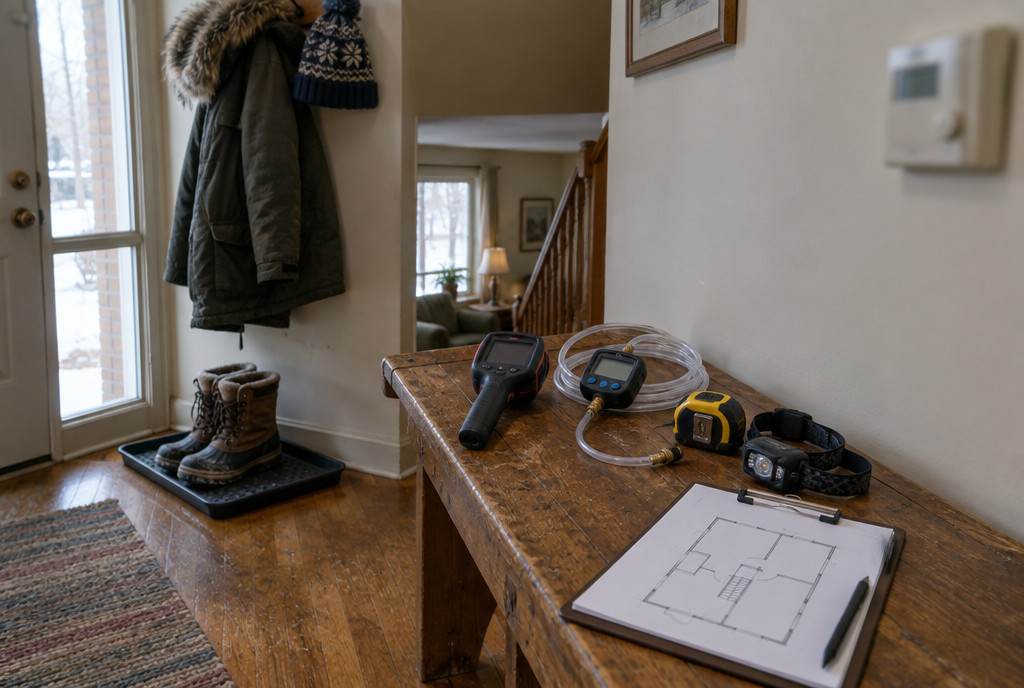
Of Victoria's 14,695 houses (single-detached, semi-detached, row houses and duplexes), 59% were built before 1961 and 84% before 1991, according to the 2021 Census. The typical Victoria house dates from 1946–1960, and an evaluation is how you find out what that means for yours: the blower door measures air leakage, the advisor inspects the attic, walls, basement, windows and heating system, and the report ranks upgrades by what they'd save.
Victoria gets about 2,763 heating degree-days a year, a measure of how much heating its climate needs, and its winter design temperature, the cold day heating systems are sized for, is −1.3°C. Those figures come from the climate data for Victoria Gonzales in HOT2000, the home-energy software Natural Resources Canada (NRCan) gives energy advisors. That's the 3rd-lowest heating demand of the 70 cities we cover. With winters this mild, an evaluation is as much about comfort, damp and planning a heat pump that also cools as it is about cutting the heating bill.
Wildfire smoke reaches Victoria in some summers. The Government of Canada's advice is to keep windows and doors closed, limit exhaust fans and use the best filter your system can handle, so ask the advisor what your furnace or HRV can take.
In the Victoria area, 37% of households heat mainly with electric baseboards, 23% with a heat pump and about 16% with a forced-air furnace; electricity is the main heating energy for 46% of households and natural gas for 23% (Statistics Canada, 2023). The heating system on the report shapes the recommendations: a forced-air furnace invites a ducted heat pump, electric baseboards a ductless one.
What it costs in Victoria
There's no provincial price list; the City of Nanaimo quotes $400–$500 as typical for an existing home. Several B.C. municipalities subsidize evaluations for their residents (see local programs below).
Most providers quote the initial (pre-upgrade) and follow-up (post-upgrade) visits separately. Rebate programs that pay on measured improvement need both, so ask for the combined price.
How a home energy assessment (EnerGuide evaluation) works
- Initial evaluation, about 2–3 hours. The advisor measures and inspects the house and runs the blower door test.
- Report and EnerGuide rating. You get the home's energy rating in gigajoules per year and a list of recommended upgrades with estimated savings.
- Do the work. Most rebate programs only count upgrades done after the initial evaluation.
- Follow-up evaluation. A second visit measures the improvement, which is what most rebates pay on.
Coastal BC Lower Mainland and Vancouver Island
Victoria’s climate: Coastal BC
Mild, wet winters and summer heat waves: fix moisture first, then cooling and heat pumps.
Coastal BC has Canada's mildest winters, but heavy rain from fall to spring soaks walls and roofs, and summer heat waves are now a health risk. Heating needs are the lowest of any region we cover, so damp, drafts and overheating are the common complaints. An EnerGuide evaluation here should look for moisture problems before any air sealing or insulation, then plan a heat pump that heats and cools.
In Victoria: Victoria's winter cold snaps are the mildest of any city we cover, rarely below −4°C, and nearly 1 in 4 area homes already heats with a heat pump. Summers are cool and very dry, so damp is mainly a winter issue.
Fix moisture before tightening up
Heavy winter rain soaks walls and roofs here. Insulation makes outer layers colder and slower to dry, so fix leaks, condensation and mould first, or upgrades can trap water.
Plan cooling before the next heat wave
Heat waves are now a real health risk on the coast. Health authorities recommend efficient active cooling, such as a ductless heat pump, so at least one room stays cool.
Plan the switch to a heat pump
Almost all winter heating here happens at temperatures where heat pumps work efficiently, and one system can replace baseboards or a gas furnace and add cooling.
When to book: Book the evaluation between October and March, when rain shows where moisture gets in and cold mornings suit thermal scans. Start a 3-month radon test in fall, and get cooling installed before summer.
Everything homes in Victoria need →
Sources for this climate guide · checked October 26, 2026
- National Building Code of Canada 2020, climate data (NRC)
- Canadian Climate Normals 1991–2020 (ECCC)
- Keeping the Heat In (NRCan)
- Air-Source Heat Pump Sizing and Selection Guide (NRCan)
- Heat pump basics (NRCan)
- Heating and Cooling With a Heat Pump (NRCan)
- Primary heating systems by household, Table 38-10-0286-01 (Statistics Canada)
- Electricity price comparison, April 2025 (Hydro-Québec)
- BC Coroners Service review of 2021 heat deaths
- Wildfire smoke, filtration and cooling (Island Health)
- Wildfire smoke: protecting your health (Government of Canada)
- Canada's top weather stories of 2020 (ECCC)
- Canada's most impactful weather stories of 2024 (ECCC)
- 2024 Cross-Canada Survey of Radon Exposure
- Guide for Radon Measurements in Homes (Health Canada)
- Conditions for thermal scans, ASTM C1060 summary (Cx Associates)
NRCan-licensed service organizations serving Victoria
A service organization is a company that Natural Resources Canada (NRCan) licenses to deliver EnerGuide evaluations; its registered energy advisors do the home visit. Every organization below is licensed by NRCan to deliver EnerGuide evaluations and lists Victoria postal codes. Coverage is the share of Victoria's urban postal areas each one lists.
- Acacia Engineering
- Canada Energy Audit Profile
- Capital Home Energy
- City Green Solutions
- CoEfficient Building Science
- DW Energy Advisors
- Energy Werx Profile
- Enerhold Engineering Solutions
- Enerhome Consulting
- EnerSolution Profile
- EnerTech Solutions
- ER Energy Solutions
- GETS Energy
- Green Canada Home Advisors Profile
- Green Think
- Greenbrain Profile
- HomeTech Energy Solutions
- Isle Energy Consulting
- NRGwise (A1 NRGwise Consulting) Profile
- Sensible Home Inspections
- The Energuy Profile
- VerdaTech Energy Management and Consulting
Rebates and financing an evaluation unlocks in Victoria
Home energy audit in Victoria: common questions
How much does a home energy audit cost in Victoria?
There's no provincial price list; the City of Nanaimo quotes $400–$500 as typical for an existing home. Several B.C. municipalities subsidize evaluations for their residents (see local programs below).
How many companies do EnerGuide evaluations in Victoria?
NRCan's list of service organizations shows 22 licensed organizations with Victoria postal codes (checked September 25, 2026).
How long does an EnerGuide evaluation take?
The initial visit usually takes two to three hours, including the blower door test. The follow-up visit after upgrades is shorter.
Which rebates need an EnerGuide evaluation in British Columbia?
Currently: BC Home Energy Improvement Bonus ($20 for every percentage-point your home improves — $750 minimum, $2,000 maximum — or $300 for any two upgrades). Check the program page for current terms before you book.