How Saint John is built
- Before 1961 34%
- 1961–1990 44%
- 1991–2000 9%
- 2001 or later 13%
Why Saint John homes get humidity problems
Saint John gets about 4,580 heating degree-days a year, a measure of how much heating its climate needs, and its winter design temperature, the cold day heating systems are sized for, is −22.5°C. Those figures come from the climate data for Saint John in HOT2000, the home-energy software Natural Resources Canada (NRCan) gives energy advisors. On Saint John's coldest days, window glass and poorly insulated corners get cold enough for condensation at humidity levels that feel normal indoors, so winter humidity needs to stay at the lower end of the comfortable range.
Of Saint John's 19,705 houses (single-detached, semi-detached, row houses and duplexes), 34% were built before 1961 and 78% before 1991, according to the 2021 Census. Newer houses (12% of Saint John's were built since 2001) are tight and usually have an HRV or ERV that needs balancing and cleaning. Older houses that get air-sealed can lose the accidental ventilation they used to rely on.
What the assessment measures
- Relative humidity in living areas and the basement.
- Actual airflow from bath and kitchen fans, and whether they vent outside rather than into the attic.
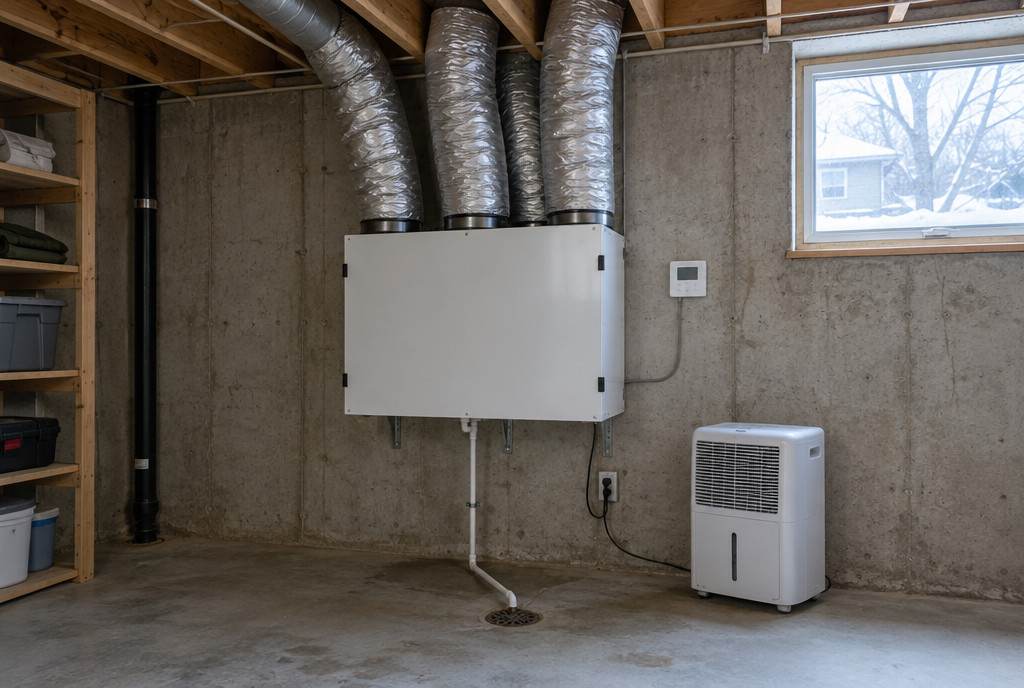
- How much fresh air the house gets, and whether an HRV or ERV is balanced.
Related tests in Saint John
Atlantic Canada Maritimes and Newfoundland
What this means in Saint John’s climate
Damp, windy, icy winters and costly oil: switch to heat pumps, seal, test for radon.
Why it matters here: Damp air and heavy rain make moisture the main risk; this checks fans, indoor humidity and signs of mould.
Best timing: Late fall or the spring wet season.
- Fix moisture before you insulate. Halifax, St. John's, Saint John and Charlottetown get enough wind-driven rain that new walls must have a rainscreen. Stop water getting into walls and basements before adding insulation. Ask: Ask the advisor to check the basement, attic sheathing and walls under windows for damp, and how bath fans vent.
What else homes in Saint John need →
Sources for this climate guide · checked October 26, 2026
- National Building Code of Canada 2020, climate data (NRC)
- Canadian Climate Normals 1991–2020 (ECCC)
- Keeping the Heat In (NRCan)
- Heat pumps, Canada Greener Homes (NRCan)
- Heat pump basics (NRCan)
- Heating and Cooling With a Heat Pump (NRCan)
- Primary heating systems by household, Table 38-10-0286-01 (Statistics Canada)
- Household heating oil prices, Table 18-10-0001-01 (Statistics Canada)
- Electricity price comparison, April 2025 (Hydro-Québec)
- Prevent oil tank spills (Government of Nova Scotia)
- Canada's top weather stories of 2019 (ECCC)
- Canada's top weather stories of 2022 (ECCC)
- Canada's top weather stories of 2023 (ECCC)
- 2024 Cross-Canada Survey of Radon Exposure
- Guide for Radon Measurements in Homes (Health Canada)
- Conditions for thermal scans, ASTM C1060 summary (Cx Associates)
- Canada's top weather stories of 2018 (ECCC)
- Canada's most impactful weather stories of 2024 (ECCC)
NRCan-licensed service organizations serving Saint John
A service organization is a company that Natural Resources Canada (NRCan) licenses to deliver EnerGuide evaluations; its registered energy advisors do the home visit. Advisors assess ventilation and humidity as part of an evaluation and check that exhaust fans actually vent outside. Sizing an HRV or ERV may be extra.
- Enercheck Solutions
- Homesol Building Solutions
- RU-Green Energy Solutions
- ThermalWise Green Building Cooperative
Programs in Saint John
Ventilation and humidity assessment in Saint John: common questions
HRV or ERV?
Both bring in fresh air and recover heat. An ERV also transfers some moisture, which helps keep very dry winter air from getting drier; an HRV suits houses that tend to run humid.
Why did condensation appear after we got new windows?
Tighter windows cut accidental air leakage, so humidity builds up. The fix is usually controlled ventilation, not leakier windows.
Is a ventilation assessment part of an EnerGuide evaluation in Saint John?
Advisors assess ventilation and humidity during the evaluation; HRV or ERV sizing may be an extra service.