How Whitehorse is built
- Before 1961 8%
- 1961–1990 41%
- 1991–2000 16%
- 2001 or later 35%
Why it matters in Whitehorse
Whitehorse has no piped natural gas for homes, so combustion appliances here are mostly oil, propane or wood, and each needs its own venting check.
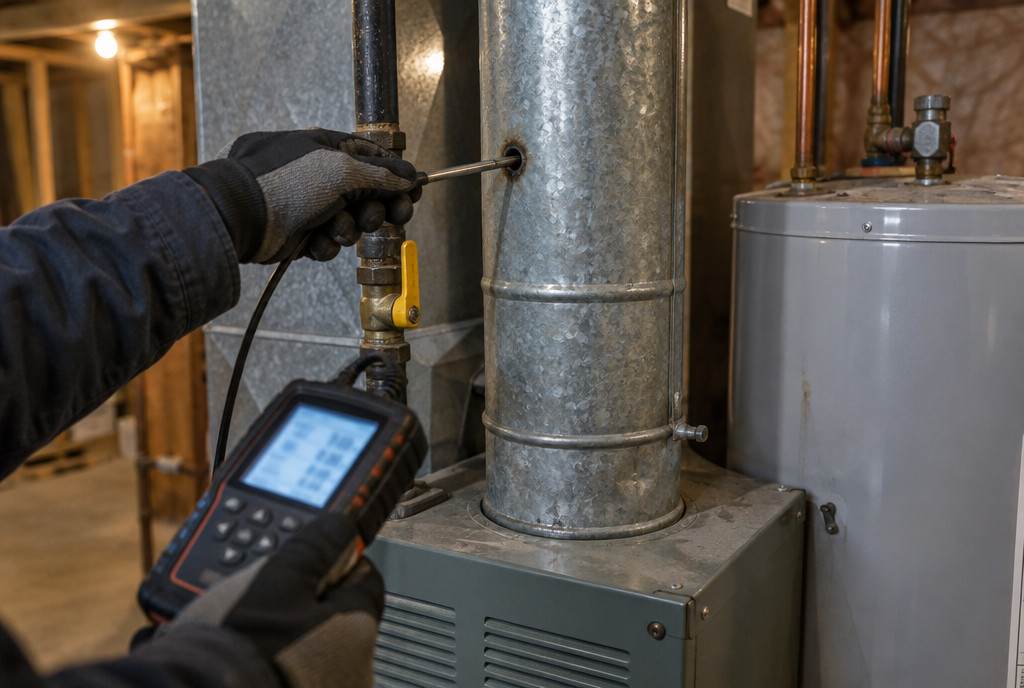
The risk rises after air sealing: a tighter house plus a strong exhaust fan or dryer can pull exhaust back down a chimney. That's why advisors test for spillage during an evaluation and why it should be repeated after serious tightening.
The CO alarm rule in Yukon
Yukon requires CO detectors in every residence with a fuel-burning appliance or attached garage.
What the check involves
- Worst-case depressurization: exhaust fans and the dryer on, doors set to make the appliance room as negative as it gets.
- A spillage and draft check at each appliance, with a CO reading.
- A plan if anything fails: often a sealed-combustion appliance or a fix to the venting, done by a licensed gas or oil technician.
The North Yukon, NWT and Nunavut
What this means in Whitehorse’s climate
Extreme cold and costly energy: envelope first, reliable heat, safe oil tanks, permafrost.
Why it matters here: Oil and propane heat many homes, and a tighter house can cause backdrafting.
Best timing: With the blower door visit.
- Keep heat reliable and oil tanks safe. Oil is the main fuel, and losing heat at −40°C is serious. Permafrost movement can tilt oil tanks and strain fuel lines. Ask: Ask the advisor to check the burner, venting and CO alarms, and to look for a leaning tank or bent supply line.
What else homes in Whitehorse need →
Sources for this climate guide · checked October 26, 2026
- National Building Code of Canada 2020, climate data (NRC)
- Canadian Climate Normals 1991–2020 (ECCC)
- Keeping the Heat In (NRCan)
- Air-Source Heat Pump Sizing and Selection Guide (NRCan)
- Heat pumps, Canada Greener Homes (NRCan)
- Heating and Cooling With a Heat Pump (NRCan)
- Yukon Energy Facts 2024 (Yukon Bureau of Statistics)
- Household heating oil prices, Table 18-10-0001-01 (Statistics Canada)
- Residential electricity rates, April 2026 (ATCO Electric Yukon)
- Residential rate schedule, July 2026 (Naka Power, Yellowknife)
- Rates and riders (Naka Power, Yellowknife)
- Energy profile: Northwest Territories (Canada Energy Regulator)
- Energy profile: Yukon (Canada Energy Regulator)
- Keep Your House on Solid Ground: permafrost guide (Government of the NWT)
- Permafrost in Nunavut: a homeowner's guide (Government of Nunavut)
- Permafrost thaw mapping, Whitehorse area (Yukon University)
- 2024 Cross-Canada Survey of Radon Exposure
- Guide for Radon Measurements in Homes (Health Canada)
- Canada's top weather stories of 2022 (ECCC)
- Canada's top weather stories of 2023 (ECCC)
- Conditions for thermal scans, ASTM C1060 summary (Cx Associates)
NRCan-licensed service organizations serving Whitehorse
In Yukon, the territorial government's Energy Branch is the licensed service organization and arranges assessments with local energy advisors.
A service organization is a company that Natural Resources Canada (NRCan) licenses to deliver EnerGuide evaluations; its registered energy advisors do the home visit. Energy advisors check for combustion spillage during an evaluation; fixing a venting problem is work for a licensed gas or oil technician.
- Government of Yukon Energy Mines and Resources
Combustion safety test in Whitehorse: common questions
Are CO alarms required in Whitehorse homes?
Yukon requires CO detectors in every residence with a fuel-burning appliance or attached garage.
Who does combustion safety testing?
Energy advisors check for spillage during an EnerGuide evaluation. Repairs to venting or appliances are done by a licensed gas or oil technician.
I have CO alarms. Isn't that enough?
Alarms warn you once CO is already in the house. A spillage test finds a venting problem before it produces CO.