How Whitehorse is built
- Before 1961 8%
- 1961–1990 41%
- 1991–2000 16%
- 2001 or later 35%
What an evaluation finds in Whitehorse homes
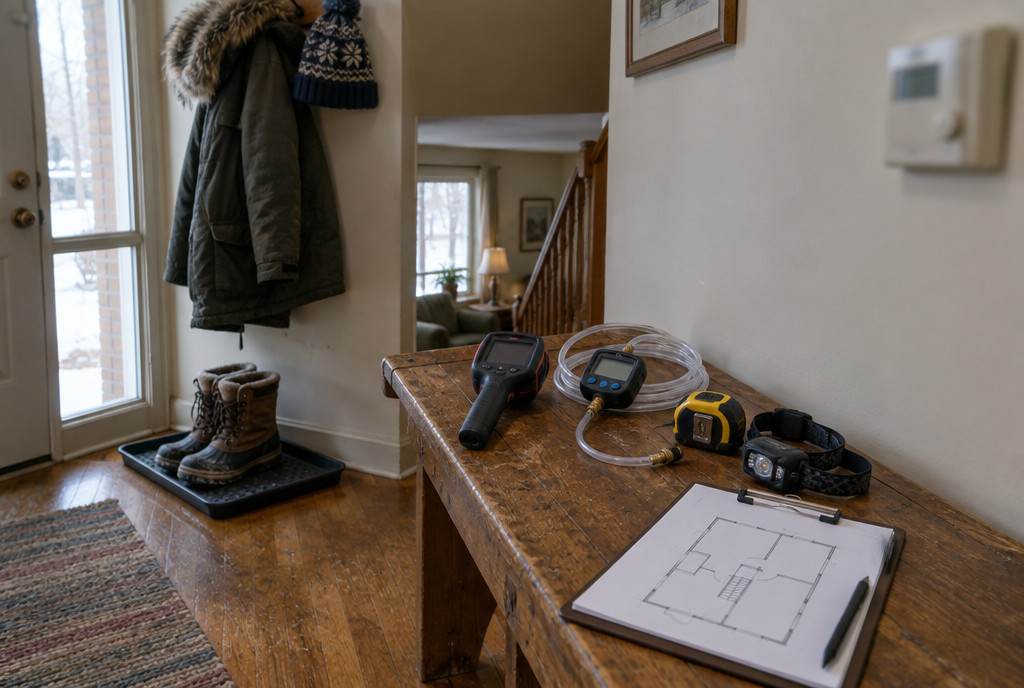
Of Whitehorse's 9,485 houses (single-detached, semi-detached, row houses and duplexes), 8% were built before 1961 and 48% before 1991, according to the 2021 Census. The typical Whitehorse house dates from 1991–1995, and an evaluation is how you find out what that means for yours: the blower door measures air leakage, the advisor inspects the attic, walls, basement, windows and heating system, and the report ranks upgrades by what they'd save.
Whitehorse gets about 6,522 heating degree-days a year, a measure of how much heating its climate needs, and its winter design temperature, the cold day heating systems are sized for, is −36.4°C. Those figures come from the climate data for Whitehorse in HOT2000, the home-energy software Natural Resources Canada (NRCan) gives energy advisors. That's the 2nd-highest heating demand of the 70 cities we cover. Very cold winters: heating dominates, and a heat pump needs cold-climate ratings and backup heat.
Wildfire smoke reaches Whitehorse in some summers. The Government of Canada's advice is to keep windows and doors closed, limit exhaust fans and use the best filter your system can handle, so ask the advisor what your furnace or HRV can take.
What it costs in Whitehorse
Yukon's Good Energy program arranges reduced-cost assessments with local energy advisors: $50 for a pre-renovation assessment and $50 for the return visit.
How a home energy assessment (EnerGuide evaluation) works
- Initial evaluation, about 2–3 hours. The advisor measures and inspects the house and runs the blower door test.
- Report and EnerGuide rating. You get the home's energy rating in gigajoules per year and a list of recommended upgrades with estimated savings.
- Do the work. Most rebate programs only count upgrades done after the initial evaluation.
- Follow-up evaluation. A second visit measures the improvement, which is what most rebates pay on.
The North Yukon, NWT and Nunavut
Whitehorse’s climate: The North
Extreme cold and costly energy: envelope first, reliable heat, safe oil tanks, permafrost.
The North has the longest, coldest winters we cover, with temperatures that reach −41°C. About half of Yukon homes heat with oil, and electricity costs more than in southern cities, so every bit of heat kept in saves real money. An EnerGuide evaluation here should put the building envelope first, then check heating reliability, oil tank safety, ventilation and humidity limits, and signs of permafrost movement.
In Whitehorse: Whitehorse has cold snaps to −41°C and permafrost under parts of the area, which Yukon University has mapped for thaw sensitivity. Electricity costs about 26¢/kWh and oil heats about half of Yukon homes, so envelope upgrades come first.
Envelope first: seal, insulate, upgrade windows
With the coldest winters we cover and costly fuel, envelope work saves more than equipment changes. Today's new-home minimums here, about R-59 attics and R-22 walls, are good targets.
Keep heat reliable and oil tanks safe
Oil is the main fuel, and losing heat at −40°C is serious. Permafrost movement can tilt oil tanks and strain fuel lines.
Ventilate within humidity limits
A tight house needs fresh air, but at −40°C indoor relative humidity must stay very low, about 12% to 20% depending on the windows, to avoid frost and condensation.
When to book: Book the evaluation between October and April, when the cold makes leaks easy to find. Start a 3-month radon test in the heating season, and check the foundation in late summer, when thaw is deepest.
Everything homes in Whitehorse need →
Sources for this climate guide · checked October 26, 2026
- National Building Code of Canada 2020, climate data (NRC)
- Canadian Climate Normals 1991–2020 (ECCC)
- Keeping the Heat In (NRCan)
- Air-Source Heat Pump Sizing and Selection Guide (NRCan)
- Heat pumps, Canada Greener Homes (NRCan)
- Heating and Cooling With a Heat Pump (NRCan)
- Yukon Energy Facts 2024 (Yukon Bureau of Statistics)
- Household heating oil prices, Table 18-10-0001-01 (Statistics Canada)
- Residential electricity rates, April 2026 (ATCO Electric Yukon)
- Residential rate schedule, July 2026 (Naka Power, Yellowknife)
- Rates and riders (Naka Power, Yellowknife)
- Energy profile: Northwest Territories (Canada Energy Regulator)
- Energy profile: Yukon (Canada Energy Regulator)
- Keep Your House on Solid Ground: permafrost guide (Government of the NWT)
- Permafrost in Nunavut: a homeowner's guide (Government of Nunavut)
- Permafrost thaw mapping, Whitehorse area (Yukon University)
- 2024 Cross-Canada Survey of Radon Exposure
- Guide for Radon Measurements in Homes (Health Canada)
- Canada's top weather stories of 2022 (ECCC)
- Canada's top weather stories of 2023 (ECCC)
- Conditions for thermal scans, ASTM C1060 summary (Cx Associates)
NRCan-licensed service organizations serving Whitehorse
In Yukon, the territorial government's Energy Branch is the licensed service organization and arranges assessments with local energy advisors.
A service organization is a company that Natural Resources Canada (NRCan) licenses to deliver EnerGuide evaluations; its registered energy advisors do the home visit. Every organization below is licensed by NRCan to deliver EnerGuide evaluations and lists Whitehorse postal codes. Coverage is the share of Whitehorse's urban postal areas each one lists.
- Government of Yukon Energy Mines and Resources
Home energy audit in Whitehorse: common questions
How much does a home energy audit cost in Whitehorse?
Yukon's Good Energy program arranges reduced-cost assessments with local energy advisors: $50 for a pre-renovation assessment and $50 for the return visit.
How many companies do EnerGuide evaluations in Whitehorse?
NRCan's list of service organizations shows 1 licensed organization with Whitehorse postal codes (checked September 25, 2026).
How long does an EnerGuide evaluation take?
The initial visit usually takes two to three hours, including the blower door test. The follow-up visit after upgrades is shorter.