How Yellowknife is built
- Before 1961 3%
- 1961–1990 54%
- 1991–2000 21%
- 2001 or later 22%
The rule in Northwest Territories
We found no NWT requirement for CO alarms in existing homes; the territory's fire regulations adopt the national codes for new construction.
Where CO alarms go: installation rules in Northwest Territories
What the rules say about installing alarms:
- We found no territorial requirement for existing homes; the NWT applies the 2020 National Building Code to new construction.
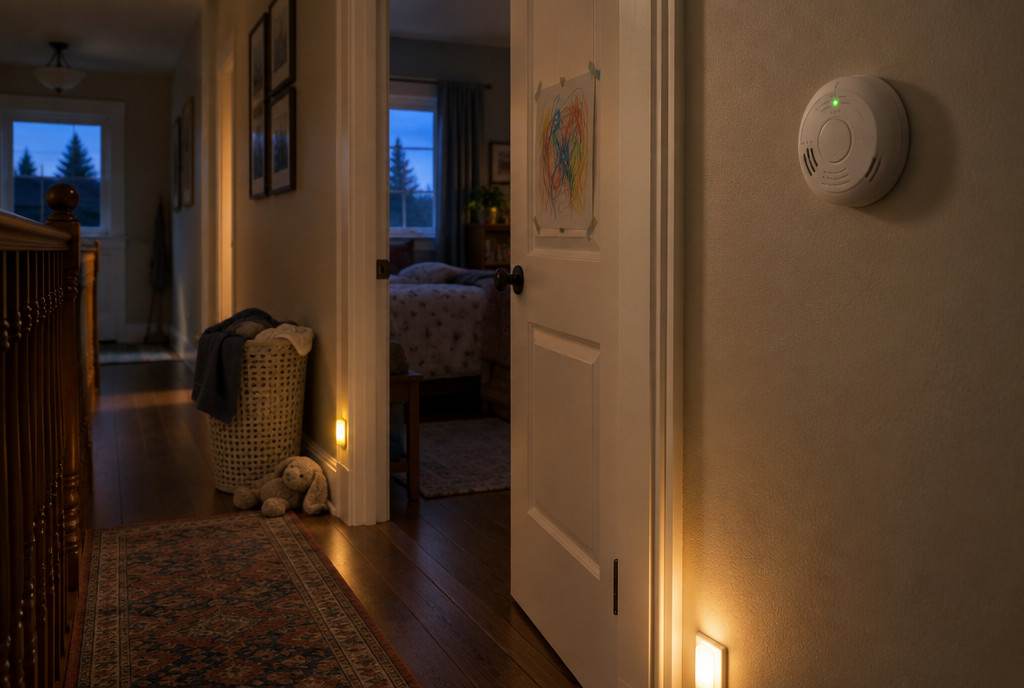
- For new houses, the National Building Code 2020 (Article 9.32.3.9) requires a CO alarm inside each bedroom or within 5 m outside each bedroom door when the home has a fuel-burning appliance or an attached garage, an alarm in any room with a solid-fuel-burning appliance (on or near the ceiling unless the maker's instructions say otherwise), and interconnected alarms in a house with a secondary suite.
CO sources in Yellowknife homes
There's no piped natural gas for homes in Yellowknife, so the usual CO sources are oil furnaces, propane appliances, wood stoves and attached garages.
Single-detached houses make up 44% of Yellowknife's households; many have an attached garage, another reason to put an alarm near the door into the house.
What a CO check involves
- Alarms next to sleeping areas and on every storey, tested monthly and replaced by their end-of-life date (usually 7 to 10 years).
- Annual service of fuel-burning appliances by a licensed technician.
- A combustion spillage test during an energy evaluation, which catches a venting problem before it produces CO.
Our carbon monoxide guide · Combustion safety testing in Yellowknife
The North Yukon, NWT and Nunavut
What this means in Yellowknife’s climate
Extreme cold and costly energy: envelope first, reliable heat, safe oil tanks, permafrost.
The North has the longest, coldest winters we cover, with temperatures that reach −41°C. About half of Yukon homes heat with oil, and electricity costs more than in southern cities, so every bit of heat kept in saves real money. An EnerGuide evaluation here should put the building envelope first, then check heating reliability, oil tank safety, ventilation and humidity limits, and signs of permafrost movement.
- Keep heat reliable and oil tanks safe. Oil is the main fuel, and losing heat at −40°C is serious. Permafrost movement can tilt oil tanks and strain fuel lines. Ask: Ask the advisor to check the burner, venting and CO alarms, and to look for a leaning tank or bent supply line.
What else homes in Yellowknife need →
Sources for this climate guide · checked October 26, 2026
- National Building Code of Canada 2020, climate data (NRC)
- Canadian Climate Normals 1991–2020 (ECCC)
- Keeping the Heat In (NRCan)
- Air-Source Heat Pump Sizing and Selection Guide (NRCan)
- Heat pumps, Canada Greener Homes (NRCan)
- Heating and Cooling With a Heat Pump (NRCan)
- Yukon Energy Facts 2024 (Yukon Bureau of Statistics)
- Household heating oil prices, Table 18-10-0001-01 (Statistics Canada)
- Residential electricity rates, April 2026 (ATCO Electric Yukon)
- Residential rate schedule, July 2026 (Naka Power, Yellowknife)
- Rates and riders (Naka Power, Yellowknife)
- Energy profile: Northwest Territories (Canada Energy Regulator)
- Energy profile: Yukon (Canada Energy Regulator)
- Keep Your House on Solid Ground: permafrost guide (Government of the NWT)
- Permafrost in Nunavut: a homeowner's guide (Government of Nunavut)
- Permafrost thaw mapping, Whitehorse area (Yukon University)
- 2024 Cross-Canada Survey of Radon Exposure
- Guide for Radon Measurements in Homes (Health Canada)
- Canada's top weather stories of 2022 (ECCC)
- Canada's top weather stories of 2023 (ECCC)
- Conditions for thermal scans, ASTM C1060 summary (Cx Associates)
Carbon monoxide testing in Yellowknife: common questions
Are carbon monoxide alarms mandatory in Yellowknife?
We found no NWT requirement for CO alarms in existing homes; the territory's fire regulations adopt the national codes for new construction.
Where should CO alarms go in Northwest Territories?
We found no territorial requirement for existing homes; the NWT applies the 2020 National Building Code to new construction. For new houses, the National Building Code 2020 (Article 9.32.3.9) requires a CO alarm inside each bedroom or within 5 m outside each bedroom door when the home has a fuel-burning appliance or an attached garage, an alarm in any room with a solid-fuel-burning appliance (on or near the ceiling unless the maker's instructions say otherwise), and interconnected alarms in a house with a secondary suite.
How long do CO alarms last?
Most have an end-of-life date of 7 to 10 years printed on the unit; replace them by then even if they still beep when tested.